Daniel Sempere
The Shadow of the WindDaniel Sempere is the first-person narrator whose life becomes entwined with the mystery of Julian Carax after he adopts one of Carax’s novels from the Cemetery of Forgotten Books. His movement from a child’s wonder at a hidden library to an adult’s pursuit of painful, deliberately withheld histories makes him both investigator and inheritor: the story he tells is also a record of how books, testimony, and memory can preserve lives that violence and silence threaten to erase.
Identity and Background
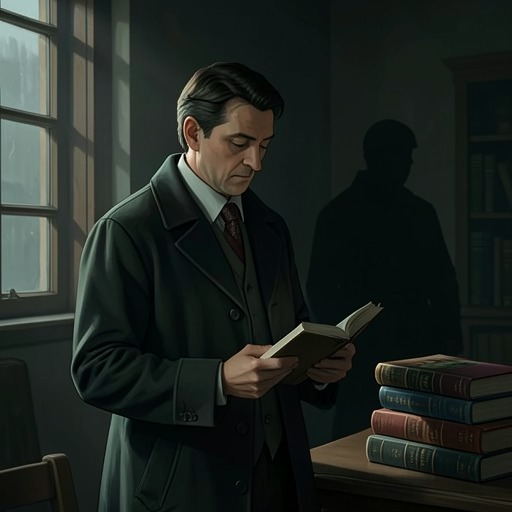
In early summer 1945, Daniel’s father takes him through Barcelona to the Cemetery of Forgotten Books. Daniel is not yet eleven, and his father tells the keeper, Isaac, that the boy will one day inherit the bookshop and is old enough to be shown the place. Within the library’s intricate maze of galleries and shelves, Daniel discovers The Shadow of the Wind by Julian Carax. He has never heard of either the title or its author, but the wine-coloured binding and gold lettering draw him to the volume. He chooses it with the sense that the book has been waiting for him, beginning a bond that shapes his adult life.
The narrative is told retrospectively by Daniel, who reconstructs events through his own experience and through accounts entrusted to him by others. His account is therefore not simply a chronological record: childhood recollections, later investigations, and Nuria Monfort’s written testimony converge around the novel and its author. Daniel’s personal perspective gives the history its emotional continuity, while the evidence he gathers makes clear that his understanding is gradual and sometimes delayed.
Life and Plot Trajectory
As a boy, Daniel is captivated by the idea of becoming a writer. He asks his father for Victor Hugo’s fountain pen and receives a promise that it will be bought if Daniel finishes a first work. The ambition fades as mechanical toys and wind-up boats capture his attention, and he stops asking for the pen. The episode reveals both his early imaginative life and his father’s limited means: Daniel remembers the older man in an oversized suit and a secondhand hat, unable to afford an object that had come to seem essential to his son.
Daniel’s search for Carax’s past develops alongside his ordinary work in the family bookshop. After Fermín Romero de Torres joins the shop, Daniel has more free time and turns back to the Carax mystery, while also seeking renewed company with Tomás Aguilar. As Daniel investigates, he moves through apartments and other places marked by earlier lives, including a neglected home where the entrance gives way onto a dark, dust-covered corridor. Such discoveries make the past tangible without making it simple: physical traces invite inquiry, but the people connected to them have often concealed or lost the stories that would explain them.
Eight years after finding the novel, Daniel approaches Nuria Monfort and tells her that he found a Carax book in the Cemetery of Forgotten Books, where she had hidden it to save it from a man calling himself Laín Coubert. Later, Daniel tells Bea Aguilar the story of his own involvement, beginning with the morning he realized he could no longer remember his mother’s face. He recounts his first visit to the library, his reading of Carax’s novel, his encounter with the faceless man, and the letter signed by Penélope Aldaya that he has carried without understanding its significance. In telling the story, he recognizes its recurring pattern of loneliness, absence, and loss—and how the novel’s world has become difficult to separate from his own.
The inquiry leads Daniel and Bea to the Aldaya mansion, where he descends into a crypt and discovers two white coffins. On the larger coffin, he makes out Penélope Aldaya’s name and the dates 1902–1919. The discovery brings a concealed history into the present through a stark physical record, but it does not immediately settle Daniel’s questions. Afterward, he and Bea leave the mansion and ride away together; she holds his hand, but does not respond when he tries to kiss her. Their closeness and distance remain side by side, as the revelations he pursues carry consequences in his relationships as well as in his understanding of Carax.
Key Actions and Objectives
Daniel’s central objective is to understand what happened to Carax and why the author’s novel has been targeted for destruction. His first decisive action is the adoption of The Shadow of the Wind, an act that begins as a child’s choice and becomes the reason he seeks out people who knew its author. When he finally speaks to Nuria, he does not claim knowledge he lacks: he explains how he came to the book and what he believes about her role in hiding it. His honesty wins her attention and opens a path toward testimony.
Daniel’s relationship to evidence is complicated by fear and self-protection. After Bea’s father confronts him by telephone, Daniel recognizes that he has tried to remain anonymous rather than accept responsibility for the effect his actions may have on Bea. He connects this evasion to an earlier failure to act when Inspector Fumero attacked Fermín. The recognition matters because Daniel’s investigation is not only a pursuit of other people’s secrets; it forces him to confront the ways he, too, has avoided showing his face when someone he cares about is at risk.
His most consequential action is to receive and preserve Nuria’s account. In her message, she asks him to remember her and entrusts him with the task of setting her story free. Daniel becomes the recipient of a history that its author fears she may not survive to tell in person. The act of listening and carrying that testimony forward contrasts with the silence that has governed the older generation’s experience of war.
Relationships and Conflict
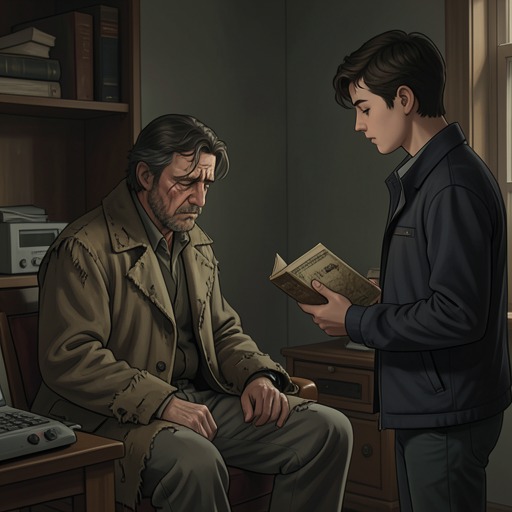
Daniel’s relationship with his father combines affection, trust, and inherited silence. His father brings him to the Cemetery of Forgotten Books and introduces him to a world of books that will define his life. Yet the same father has promised Daniel’s mother that he will not tell their son about the war or allow him to remember what happened. When he finally speaks of the promise, he admits uncertainty about whether he was right to keep it. Daniel’s family history thus contains both a gift—the library and the bookshop—and a withheld past that shapes how he learns to understand his city.
Tomás is Daniel’s childhood friend, though their friendship begins with a fight at school. Daniel had insulted Tomás’s sister, and Tomás responded with a beating that left Daniel with a lost tooth and a sharper sense of his own limits. Daniel does not tell his father or the priests what happened, and he later describes the quarrel as his own fault. Their history gives their renewed companionship an important context: friendship follows an early encounter with pride, harm, and Daniel’s reluctance to report what he has endured.
Daniel’s bond with Bea develops through the story he tells her. He lays out his connections to Carax, Nuria, and Penélope, including his earlier emotional disappointments, and admits that he has come to see the novel as a story of lonely people and absence. Bea listens without judgment and asks him to take her to the Cemetery of Forgotten Books. Their visit and their later departure from the Aldaya mansion draw them into the same investigation, but Daniel’s fear of taking responsibility strains their closeness. His feelings are real, yet the narrative measures them against his repeated impulse to hide when the consequences become serious.
Daniel also becomes connected to Nuria through the history of Carax’s novel and through her decision to leave him her account. Her trust gives him access to a past he could not have recovered by investigation alone. Through her, Daniel encounters a wider history in which private relationships and political violence have been bound together, while the act of telling becomes a final appeal to be remembered.
Change, Ending, and Narrative Role
Daniel’s understanding of the past changes as objects and testimony acquire new meanings. The novel he adopts as a child first seems to have chosen him; later, its author’s disappearance and the threats against the book turn that childhood intuition into the beginning of a dangerous inquiry. The inscription on Penélope’s coffin makes the history of the Aldaya family concrete, while the paired tombs Daniel later sees with Julian place Penélope beside David. What once appeared to be a mystery about a book becomes a chain of lives, losses, and concealed facts.
The history Daniel inherits is inseparable from war and its aftermath. Nuria describes how silence encourages people to doubt what they witnessed and how, when the voices of survivors are gone, the past can return under another name. Her words echo Daniel’s father’s earlier reluctance to speak about the war, but Daniel’s position is different: he is asked to receive what an older generation could not or would not say, and to keep it from disappearing. His role is neither that of an omniscient historian nor a detached observer. He becomes a witness by listening, remembering, and passing on another person’s testimony.
Years later, Daniel returns to the Aldaya mansion and sees how completely its function has changed. The garden has become a car park; the old library where he nearly lost his life is now a boardroom, and the room where he and Bea conceived their son is a bathroom. The transformation juxtaposes the house’s hidden history with its ordinary commercial present. Daniel’s memory preserves what its renovated rooms no longer disclose.
The novel’s closing gesture brings Daniel’s early devotion to books into contact with Carax’s survival as a writer. A parcel bearing a Paris postmark arrives at the bookshop, containing The Angel of Mist, published under the name Boris Laurent. Daniel recognizes the writing and finds a dedication in the blue strokes of the pen he had once longed for. Carax thanks Daniel for giving him back his voice and pen, and Bea for helping restore their lives. The book completes a circle begun with Daniel’s childhood adoption: the boy who chose a forgotten novel becomes the adult whose loyalty helps its author speak again. For Daniel, remembrance is not merely the recovery of a lost past; it is the work that allows people and stories to remain present.